
n8n AI Agent: Research Any Company in Seconds
Researching a company used to mean 30 minutes of tab-switching between LinkedIn, Crunchbase, their website, and Google News. For sales teams, investors, and business developers doing this dozens of ti

Researching a company used to mean 30 minutes of tab-switching between LinkedIn, Crunchbase, their website, and Google News. For sales teams, investors, and business developers doing this dozens of times a week, that adds up fast. An n8n AI agent compresses that entire process into seconds — and it runs automatically, without you touching a keyboard.
What the Workflow Actually Does
At its core, this n8n workflow takes a company name (or domain) as input and orchestrates a sequence of automated lookups across multiple data sources. The AI agent layer — typically powered by OpenAI or Claude — doesn't just retrieve data. It synthesizes it: pulling funding rounds from Crunchbase, recent news from a search API, LinkedIn signals, tech stack from BuiltWith, and contact patterns from Hunter.io, then returning a structured briefing you can act on immediately.
- Company overview: founding year, headcount, industry, HQ
- Recent news and press mentions from the last 90 days
- Tech stack and tools they're currently using
- Key decision-makers with verified email patterns
- Funding history and investor relationships
The output lands wherever you need it: a Notion database, a Google Sheet, a Slack message, or a CRM record. The workflow doesn't care — it just routes the result to the destination you configure once.
How the n8n Agent Architecture Works
n8n's AI agent node treats each data source as a tool the agent can call conditionally. This is the key difference from a linear workflow: the agent decides which lookups are necessary based on what it already knows. If Crunchbase returns a full company profile, it might skip a generic web search. If the company is too small to appear in funding databases, it pivots to scraping their website directly.
The typical node structure looks like this:
- Trigger: HTTP webhook, form submission, or scheduled batch from a spreadsheet
- Agent node: OpenAI GPT-4o or Claude with tool definitions for each API
- Tool nodes: Crunchbase, SerpAPI, Hunter.io, BuiltWith, LinkedIn (via proxy or Phantombuster)
- Output formatter: structured JSON or markdown brief
- Destination: Notion, Airtable, HubSpot, Slack, or email
Because n8n runs on your own infrastructure (or self-hosted VPS), the data never touches a third-party SaaS. For teams handling sensitive prospect lists, that's not a minor detail.
Real Use Cases That Save Hours Each Week
The most immediate ROI shows up in sales development. An SDR sending 50 outbound emails a day needs company context to personalize at scale — not one-liners pulled from a website header. This workflow feeds that context automatically before the email sequence fires.
But sales isn't the only application:
- Investor due diligence: screen 20 companies in the time it used to take to screen one, with consistent data points across every target
- Competitive intelligence: run a weekly batch on your top 10 competitors and get a digest of everything that changed
- Partnership evaluation: quickly assess whether a potential partner has the team size, funding, and tech stack that matches your integration requirements
- Account-based marketing: enrich a target account list with firmographic data before campaigns launch
The pattern is always the same: manual research that took 20–40 minutes per company becomes a background task that completes while you're doing something else.
Getting Started Without Building From Scratch
The hardest part of building this workflow isn't the n8n logic — it's wiring up the API connections correctly, handling rate limits gracefully, and structuring the agent prompt so it returns consistent output regardless of how much data it finds. Those edge cases take time to work through.
If you'd rather skip the setup work and start with a workflow that already handles those details, ready-made n8n templates include pre-configured agent workflows you can import directly into your n8n instance and adapt in under an hour. The connection logic, error handling, and output formatting are already done.
Whether you build or buy the starting point, the underlying principle is the same: company research is structured, repeatable, and data-driven — which makes it exactly the kind of task an AI agent should be handling, not a human.
Once this workflow is running, the time it frees up compounds. Every hour your team stops spending on manual lookups is an hour redirected toward the work that actually requires human judgment — the calls, the decisions, the relationships.
Ja construimos isso pra voce
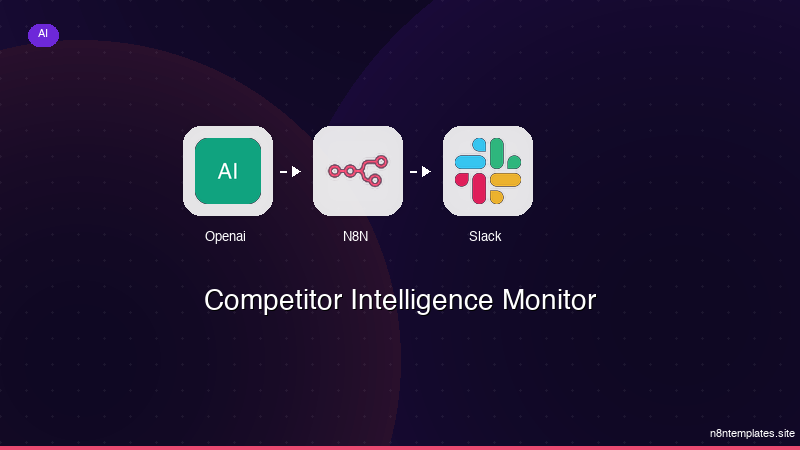
Nao comece do zero. O Competitor Intelligence Monitor e um workflow n8n pronto para instalar que faz exatamente isso — em minutos, nao horas.
Instalar por $59 →

